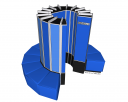

The first of a kind always holds special interest for historians and serial number one, the first Cray-1 computer system is no exception. Made in 1976 this machine, really just the prototype but proved it’s worth at 6 sites paving the way for early sales of Cray Research Supercomputers.

Serial Number 1 World Traveller From Cray Channels Magazine
In March 1976 the CRAY-1 Serial I was installed at the Los Alamos Scientific Laboratory (LASL). in Los Alamos. New Mexico. This marked the beginning of Serial 1’s extensive travels for diverse applications.
LASL is noted as being the site of the first CRAY-1 and the initial prototype testing. For six months following installation. Serial 1 underwent rigorous testing to verify workload speed and reliability demands. Performance threshold criteria were formally established in three areas: scalar-processing speed. vector processing speed and reliability. The CRAY-1 met or exceeded all performance criteria.
In September 1977 LASL replaced Serial I, a half-million word memory system, with the CRAY-1 Serial 4. a full million word memory system with automatic error correction. Thus Serial 1 left LASL to travel to the next customer in line the European Centre for Medium Range Weather Forecasts (ECMWF) based in Reading. UK. Serial 1 was shipped from CRI’s Hallie Lab (in Chippewa Falls. Wisconsin) via New York arriving in the U.K. during October. 1977.
ECMWF used Serial 1, was housed at the Rutherford National Laboratory until October 1978 when a full million word system was delivered to the Centre’s new headquarters in Reading. England. The delivery of this upgraded mainframe sent Serial 1 to a U.K. government customer who was awaiting delivery of a millionword system. While visiting Daresbury, I was extremely impressed with the facilities and struck by the high level of interest and enthusiasm exhibited by the diverse staff. There is a strong esprit de corps among the Daresbury physicists. electronics and computer experts. engineers. technicians. craftsmen. and administrators. Central to this feeling is the knowledge that the work being done at the lab will help provide scientific advances in many fields. Scientists throughout the British Isles can access the Daresbury computer network. either directly at the lab or through any of a number of universities and research institutes. Thus the CRAY-1 at Daresbury is servicing a multitude of scientific disciplines. providing the computing capability necessary to support the links between the growing experimental programs and the theoretical studies. After seeing this customer through the interim. Serial 1 was shipped to the north of England for the Science Research Council’s national laboratory at Daresbury (the feature topic of this issue of Channels).
Since June 1979. the Daresbury Lab has applied the CRAY-1 Serial 1 to its multi-faceted scientific environment. Disciplines benefiting from the availability of the Serial 1 include: protein crystallography. theoretical chemistry, atomic and molecular physics. oceanography. engineering. statistical mechanics and molecular dynamics. astrophysics, solid state physics, plasma physics and nuclear theory.
After a spell at Daresbury SN1 went to to work at a couple of MOD sites before returning to Chippewa Falls in 1989.
{Slightly edited}
See also Single bit errors caused by cosmic neutrinos story.
This from Cray Chips 1 June 1989 by Charlie Clark
“SUBJECT: THE OLD ‘WORK HORSE’ RETIRES”
It was perhaps fitting that this announcement from Charlie Clark of Cray Research (UK) Ltd was received on traditional Memorial Day:
“SN 1 the (prototype) first Cray system was powered off for the last time on 25th May 1989. The system has been in continuous service since it shipped from Chippewa on 5th March 1976, a total of 13 years 2 months and 20 days. “It is a credit to the Engineers who built it and the support staff who have maintained it over the years, that apart from the ‘occasional’ parity error (the half million word memory has no SECDED), the last set of 26 weeks statistics showed it running at 690 hours MTTI and it regularly did better than that.
“SN 1 is also well travelled, it was accepted on 1st April 1976 by LANL who kept it for 17 months before upgrading, to become one of Cray’s largest customers. Crossing the ‘pond’ it becomes Cray Research’s first international machine when it moved to ECMWF at Reading, England, in November 1977. It stayed here for 11 months while SN 9 was manufactured to replace it (ECMWF have twice upgraded through our range of computers and are currently running on an XMP/48). Staying in situ it was then taken over by the second international customer AWE while they waited for SN 11 to be built. (AWE are still successfully running SN 11, but have also added an XMP/2 to their facility) .
“After 4 months it was on its wheels again to move 200 miles north to Manchester where the Science Research Council used it for 20 months. It moved south again in February 1981 when the Atomic Energy Research Establishment installed it at their labs in Harwell (AERE now run SIN 2008 Cray 2). After 13 months it moved, in June 1982, to another government customer in England where it has served faithfully for nearly seven years.
“We will pack up SIN 1 carefully and return it to Chippewa where I am told it will have a place of honour in the Chippewa Computer Museum.
“SN1, as most of the ‘old hands’ know, has been an excellent machine and it will have a special place in many peoples memories as the one that started it all.
However, enough of this nostalgia, send us the next YMP!!
Where is SN1 Now
At the Chippewa Falls Museum of Industry and Technology More photos on link. See email confirmation below.
k.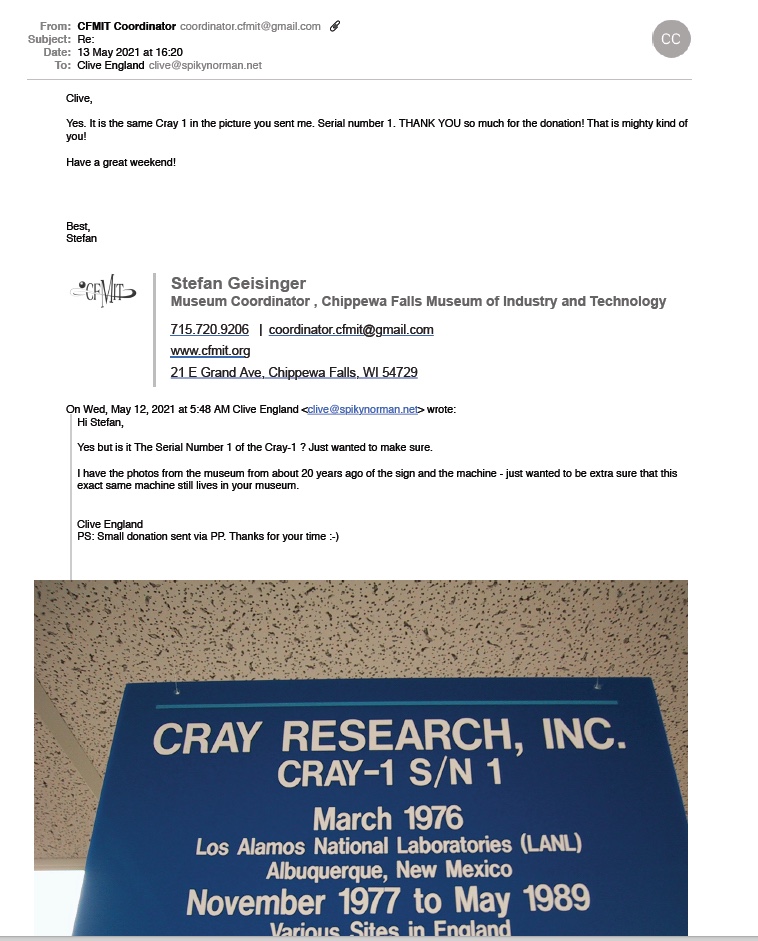
The travels continue
Serial 1 made a guest appearance at SC18 the Supercomputing conference in Dallas during 12-15 November 2018. Unboxing video here.

Curiously the nameplate lists the systems as a Cray-1B but as Serial S/N 1. Other records have SN19 as the only Cray-1B. Possibly a field upgrade was involved.

Machine SN1 at site Daresbury Lab
During it’s travels SN1 visited Daresbury in 1979. These pictures and text from the now missing page http://tardis.dl.ac.uk/computing_history/cray-1s.html
The text for the original post can be seen here. The system in the pictures is described as a Cray-1S which is possibly incorrect as SN1 was a Cray-1A or B. The later Cray-1 SN28 delivered to Daresbury was a Cray-1s.


What happened to SN2?
Serial number 2 was scrapped after NCAR persuaded CRI that built in protection against memory errors was required. See about SECDED here.