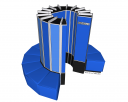

The term “Crayette” was coined by the tech magazine Datamation to describe a wave of 1980s and 1990s startup companies that built minisupercomputers. These systems aimed to deliver a fraction of a true Cray supercomputer’s power—usually using lower-cost, air-cooled CMOS components—at a drastically reduced price point, often maintaining software compatibility with Cray’s instruction set. [1, 2]
Starting with Supertek founded in 1985 by former Hewlett-Packard project manager Mike Fung, Supertek was part of a wave of companies known as “Crayettes”. These startups aimed to develop lower-cost, air-cooled hardware that could run software compiled for Cray’s multi-million dollar, liquid-cooled vector supercomputers. [1, 2, 3]
The Supertek S-1 to Cray XMS
Supertek’s primary product was the Supertek S-1, which launched in 1989. It was a compact, air-cooled system utilizing CMOS technology to clone the architecture of the legendary Cray X-MP. [1]
- After raising $21.4 million in venture capital, Supertek only managed to sell about 10 units before running into financial trouble. [1]
- Following the 1990 acquisition, Cray rebranded and sold the S-1 as the Cray XMS (pictured above). However, the hardware proved problematic and struggled to gain market traction. [1, 2, 3]
The S-2 Success: Cray Y-MP EL
At the time of the buyout, Supertek was already engineering a successor machine called the S-2, designed to clone the newer Cray Y-MP architecture. Cray took over this project and officially launched it in 1992 as the Cray Y-MP EL (Entry Level). [1]
- Unlike the XMS, the Y-MP EL was highly successful. [1]
- It drastically lowered the financial barrier to supercomputing, opening up new commercial markets for Cray in industries like oil exploration and financial services. [1, 2]
- This entry-level lineage ultimately evolved into the popular Cray J90 and SV1 series later in the 1990s.[1]
The most prominent players in the “Crayette” and minisupercomputer landscape include:
1. Convex Computer
Convex Computer was the undisputed commercial heavyweight of the Crayette era. Founded in 1982 by Bob Paluck and Steve Wallach, it successfully brought high-performance vector processing to smaller organizations. [1, 2]
- The Hardware: Their first system, the Convex C1 (1985), featured a design highly reminiscent of the iconic Cray-1 but relied on virtual memory and less expensive CMOS hardware. It ran at roughly one-fifth the speed of a full supercomputer. [1]
- The Fate: Convex saw massive success throughout the late ’80s and early ’90s. The company built an enduring partnership with Hewlett-Packard, which ultimately acquired Convex in 1995 to form its HP Exemplar technical server division. [1, 2]
2. Scientific Computer Systems (SCS)
While companies like Convex built systems inspired by Cray, Scientific Computer Systems built the ultimate literal “Crayette” by creating an exact architectural clone. [1]
- The Hardware: Their SCS-40 minisupercomputer was explicitly engineered to be instruction-set compatible with the Cray X-MP. This meant clients could plug it directly into their existing setups and run expensive Cray software right out of the box without recompiling code. [1, 2]
- The Fate: Despite their technological feat, they faced intense competition. SCS eventually pivoted away from building computer systems entirely in 1989, shifting focus toward high-speed networking software and hardware. [1]
3. Floating Point Systems (FPS)
Originally a manufacturer of popular peripheral “array processors” that boosted standard minicomputers, Floating Point Systems aggressively pushed into the standalone minisupercomputer market.
- The Hardware: They acquired Celerity Computing and developed the FPS M64 and FPS Horizonarchitectures.
- The Fate: Financial troubles caught up to them, and in a twist mirroring the Supertek acquisition, Cray Research bought out FPS’s assets in 1991. Cray turned the remaining FPS division into “Cray Research Superservers,” utilizing SPARC processors to target the business computing market. [1, 2]
4. Alliant Computer Systems
Founded in 1982 by engineering talent from Prime Computer, Alliant focused heavily on parallel vector processing. [1, 2]
- The Hardware: Their FX/Series systems bundled multiple custom vector processors together, utilizing an innovative compiler that automatically broke programs down to run simultaneously across parallel chips.
- The Fate: They found major popularity in research labs and universities but collapsed under financial pressure and a shifting market, declaring bankruptcy in 1992. [1, 2, 3, 4]
5. American Supercomputer
A lesser-known but highly pure definition of a Crayette, American Supercomputer was founded by computer architect Mike Flynn. [1]
- The Hardware: Their goal was explicitly to build a low-cost, object-code-compatible clone of the Cray architecture to capture budget-restricted engineering firms.
- The Fate: The company crashed early in its lifecycle after failing to secure vital second-round venture capital funding. [1, 2]
📉 Why the Crayette Era Ended
By the mid-1990s, the entire minisupercomputer market collapsed due to a hardware pincer movement:
- The Rise of “Killer Micros”: Standard microprocessors (like the IBM POWER2, MIPS R8000, and Intel chips) became so fast and inexpensive that a cluster of normal workstations could easily match a minisupercomputer for a fraction of the cost. [1, 2]
- Cray Fought Back: By buying Supertek and launching the entry-level Y-MP EL, Cray aggressively priced the startups out of their own niche market. [1]