Decided to do a few posts in the “Cray Supercomputer Fans” Facebook group as the 12 Crays of Christmas – enjoy.
In approx order
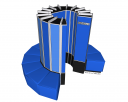
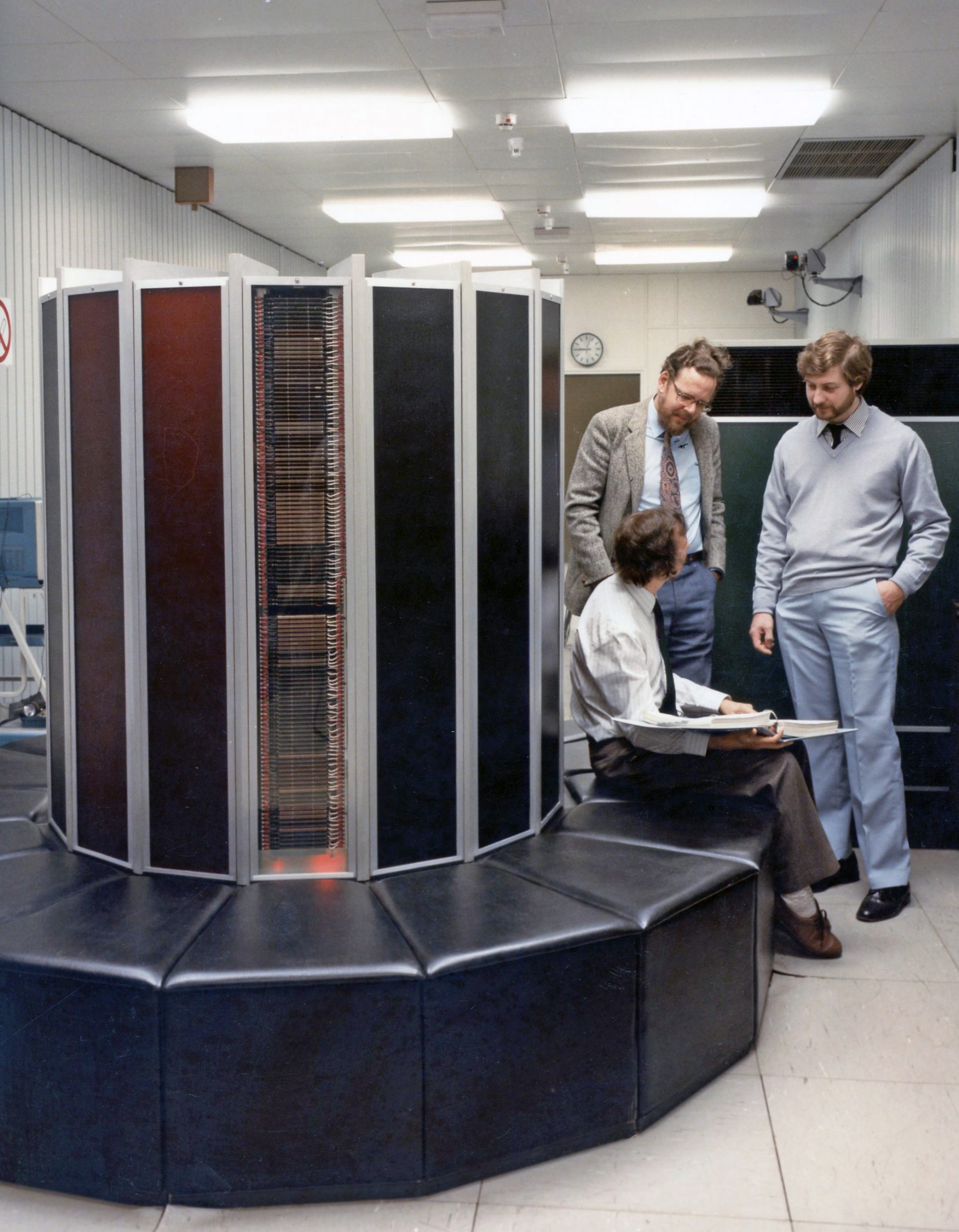
Cray-1
XMP
Cray-2
YMP-M90
C90
T3E
XT3 / Red Storm
CS6400
EL * / J90 / SV1 laterCX1
CS LV & AC
XT5h ( Black Widow)
Cray-1, Serial Number 1
With these pictures and text
Cray-1 with Disk controller in foreground. from ECMWF SN9
Fully loaded Cray X-MP with DD49 drives in the background. SSD is directly attached by high speed channel. IOPs to the right.
The outstanding Cray 2. Huge memory, 4 processors, total immersion cooling, compact size and first Cray with Unicos OS. Only 27 originally made and one later 8 processor special.
YMP M90 the big memory version of the Cray YMP architecture. Based on the second generation of YMP with larger memories and updated I/O processors.
The mid ‘90 big machine was the Cray C916. 16 processors, each a gigaflop, this sys provided an easy migration path from Y-MP systems. 60 systems delivered across a wide range of of customers also available in 2,4,8 and bigger memory versions.
In the ’90 supercomputing mostly turned away from the small number of extremely fast processors to massively parallel arrangements of 100s of processors each with individual memories. Cray followed this trend with the T3D and later the standalone T3E. Advantages were better access to processor local memory, hardware to coordinate processor activity and best of scaleability from 16 to 1024 processors. Many customers started with smaller systems then added nodes and I/O processors as time moved on. The processors evolved (by replacement) during the life of the system from 350 to 1250 MHz.
Cray moved forward into the new millennium with the Cray XT3. The core interconnection architecture was derived from the T3E but the system used AMD Operon processors. Each compute node was expand to include more memory and service nodes had external connections via PCI-X. The processor interconnection was via Cray designed Seastar chips. The first example was Sandia Red Storm but the system was commercialised around the same time. Built for reliability and long compute time tasks the cabinets were less glamorous but more functional to house up to 30,000 compute nodes. Though the performance of each XT3 model will vary with the speed and number of processors installed, the November 2007 Top500 results for the Red Storm machine, the largest XT3 machine installed at Sandia, measured 102.7 teraflops on the Linpack benchmark, placing it at #6 on the list. After upgrades in 2008 to install some XT4 nodes with quad-core Opterons, Red Storm achieved 248 teraflops to place at #9 on the November 2008 Top500. XT3s were also delivered to Swiss Met office and AWE in the UK.
The Cray CS6400 a rare machine that was the result of the acquisition of parts of Floating Point Systems. The Superserver range of systems was developed in Beaverton OR. after Cray Research purchased the assets of Floating point systems. Aimed directly at the commercial market these system used SPARC processors and a modified version of Solaris. Starting with the APP and SMP systems a development program resulted in the CS6400 shown here. Running an adjusted Solaris OS this 64 cpu beast out shone the biggest systems Sun could offer. Evolved into the Sun E10k system.
We resume the 12 Crays of Christmas with the Cray EL. This mid ’90 air cooled system brought many new to Cray customers in the door. Each of the up to 8 CPUs have the same performance as the original Cray-1 but with a fraction of the running costs. Containing electronics to smooth out dirty power and using machine room Air conditioning this system required little external infrastructure. Remote access service via a modem, where allowed by the customer, reduced service costs. A technical centre in Atlanta was created to service and the follow on smaller Cray systems. A 1/2 size version the EL94 was later released.
The 12 Cray’s of Christmas continues with the Cray CS. Air Cooled and Liquid Cooled versions of the Cray Supercluster. A product derived from Cray Acquisition of Appro. First Customer Ship was the Railway technical institute. Intel Zeon processors some with Nvidia Gpus.
There was a Cray system built like a NFL football team. The Cray XT5h – h for hybrid – incorporated three different types of computing. Like the offence, defence and special teams in the NFL the XT5h included the AMD Opteron™- based Cray XT4™ and Cray XT5™ blades, with additional vector and FPGA processor technologies. Combined together using a HyperTransport interconnect links general-purpose and reconfigurable processors this tight coupling of reconfigurable processors with AMD Opteron processors ensures low latency and high-bandwidth communication between processing elements. Using SeaStar network for XTn Blades and YARC with Connections for the vector processing X2 Blades via StarGate interface. Showing up in the NSA museum this was probably a special system for special customers. See one at Chippewa Falls Museum of Industry and Technology and Mimms Museum of Technology and Art and NSA – National Security Agency ( museum section )
Cray 1, S/N 1 at its final customer installation ~1989 Now in retirement at CFMIT in CF. This was the origin point that laid the foundation of Cray Research.